

Photobiomodulation Therapy Gold Coast
Red and near-infrared light therapy that heals at a cellular level — reducing pain, accelerating recovery, and restoring brain function. No drugs. No needles. No downtime.
What is photobiomodulation therapy?
Photobiomodulation therapy (PBMt) — also known as Low Level Laser Therapy (LLLT) or red light therapy — is one of the most exciting and evidence-backed therapies in modern medicine. It uses specific wavelengths of red and near-infrared light, delivered by clinical-grade lasers and LEDs, to trigger powerful healing responses inside your cells.
Unlike medications that mask symptoms, photobiomodulation works at the source — repairing the cellular dysfunction that causes pain, slow healing, and poor function in the first place.
The result? Faster recovery, less pain, reduced inflammation, and — in the case of brain applications — improved cognition, mood, and neurological function.
The photosynthesis analogy: Just as plants use light energy from the sun to power their biology, your cells can absorb specific wavelengths of light and use that energy to repair and regenerate. PBMt essentially recharges your body's healing capacity.
How does it work?
The science behind photobiomodulation is well-established, with thousands of peer-reviewed studies behind it. Here's how it works in plain terms:
Light penetrates tissue
Red light (600–700nm) and near-infrared light (800–1000nm) penetrate skin, muscle, and in the case of transcranial treatment, even bone — reaching the tissue where healing needs to happen. Clinical lasers reach significantly deeper than home devices.Mitochondria absorb the energy
Inside your cells, mitochondria (your cell's power generators) absorb the light through a molecule called cytochrome c oxidase. Where there is injury or chronic pain, mitochondria are typically dysfunctional — unable to produce the energy your body needs to heal. The light reactivates them.Cellular energy production surges
The activated mitochondria produce significantly more ATP — the fuel that powers every cell in your body. With more energy available, damaged cells can repair themselves, inflammation reduces, and tissue regeneration accelerates dramatically.Clear treatment plan
honest guidance on how many sessions you're likely to need and what to expectA healing cascade begins
Increased cellular energy triggers a wide range of healing responses — new blood vessel formation, reduced oxidative stress, modulation of inflammatory pathways, collagen synthesis, and improved nerve signalling. The body essentially shifts from a state of dysfunction to active repair.
Why clinical PBMt outperforms home red light panels
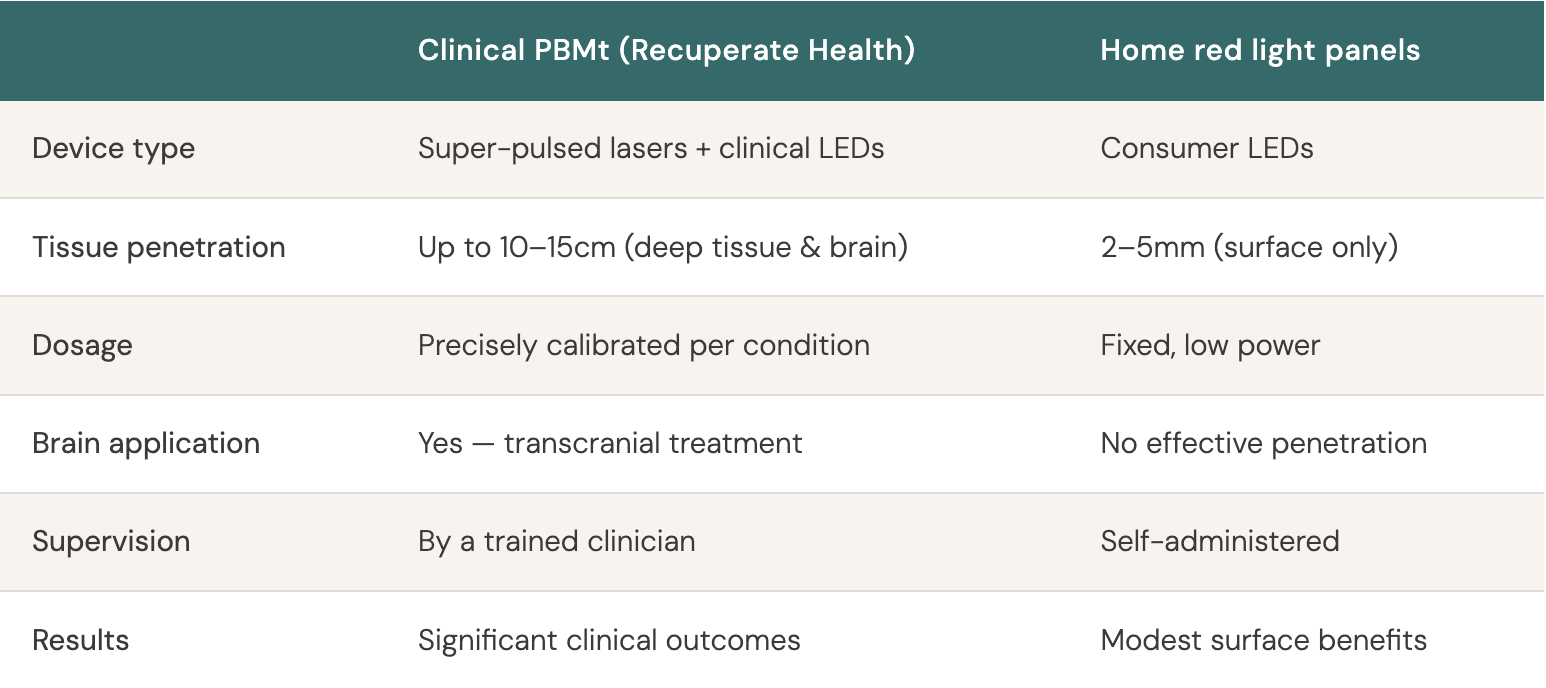
Consumer red light panels use low-powered LEDs and cannot penetrate more than a few millimetres into tissue. Clinical photobiomodulation at Recuperate Health uses super-pulsed lasers that penetrate 10–15cm into tissue, reaching deep joints, spinal structures, and — critically — the brain. The dose delivered to the target tissue is orders of magnitude higher, producing results that home devices simply cannot replicate.
What conditions does PBMt treat?
Photobiomodulation is one of the most versatile therapies available — it can be applied to virtually any tissue in the body, including the brain. At Recuperate Health, we use it to treat a wide range of conditions:
Nerve pain
Sciatica, neuropathy, nerve entrapment, radiculopathy
Sports injuries
Muscle tears, tendon injuries, ligament damage, stress fractures
Chronic pain
Back, neck, shoulder, hip, knee — pain that hasn't responded to other treatmentsNeck pain & stiffness
Traumatic Brain Injury (TBI)
One of the most compelling applications — improving function, reducing symptoms
Depression & anxiety
Modulating brain chemistry and reducing neuroinflammation without medication
Cognitive decline
Supporting memory, focus, and mental clarity as the brain ages
Inflammation
Arthritis, bursitis, tendinitis, inflammatory joint conditions
Post-surgical recovery
Accelerating healing and reducing scar tissue after operations
Fibromyalgia
Widespread pain, fatigue, and sensory sensitivity
Brain & neurological — transcranial PBMt
What is transcranial photobiomodulation? Near-infrared light can penetrate the skull and reach brain tissue. When applied transcranially, PBMt stimulates neuronal repair, increases oxygen delivery, promotes the growth of new blood vessels (angiogenesis), increases brain-derived neurotrophic factor (BDNF), and enhances myelination of nerve fibres — the processes your brain needs to heal and function optimally.
Parkinson's disease
Improving motor control and reducing disease progression markers
Alzheimer's & dementia
Supporting neuronal health and slowing cognitive deterioration
Brain performance
Athletes, executives, and students seeking enhanced mental performance
We also treat animals. Photobiomodulation is highly effective for dogs, horses, and other animals with injuries, arthritis, or neurological conditions. Contact us to discuss your animal's needs.
Photobiomodulation vs red light therapy - what's the difference?
What to expect at your appointment
Your first appointment at Recuperate Health begins with a thorough assessment — we take the time to understand not just your symptoms, but the root cause of what's driving them. PBMt is then applied precisely to the target tissue.
Assessment
Your history, symptoms, previous treatments, and goals. We determine whether body, brain, or both need to be treated.Treatment planning
Selecting the right wavelengths, dosage, and application method for your specific conditionTreatment
The laser or LED device is applied to the skin over the target area. You'll feel gentle warmth. Sessions typically run 30–60 minutes.Post-treatment
No downtime. Most patients notice some immediate improvement. Effects often continue to develop over the following 24–48 hours.Progress review
We monitor your response and adjust the treatment protocol as needed each session
How many sessions will I need? Most patients notice meaningful improvement within 3–6 sessions for musculoskeletal conditions. Neurological and brain conditions typically require a longer course of 8–12 sessions. Your clinician will give you a realistic, personalised plan at your first appointment.
Frequently Asked Questions
Does photobiomodulation hurt?
No. Photobiomodulation is completely painless and non-invasive. Most patients feel a gentle warmth during treatment. There are no needles, no medication, and no recovery time required.
Is it the same as red light therapy?
They use similar principles but clinical PBMt is far more powerful. Consumer red light devices use low-powered LEDs that only penetrate a few millimetres into tissue. Our clinical lasers penetrate up to 10–15cm — reaching deep joints, the spine, and the brain — delivering results that home panels simply cannot achieve.
Is photobiomodulation safe?
Photobiomodulation has an excellent safety record backed by decades of clinical research. It is non-thermal at therapeutic dosages, meaning it doesn't damage tissue. It is suitable for most patients, including those who cannot tolerate other treatments. Contraindications are few — your clinician will discuss these at your assessment.
Can it really treat brain conditions?
Yes — this is one of the most exciting areas of photobiomodulation research. Near-infrared light penetrates the skull and is absorbed by brain tissue, stimulating neuronal repair, increasing oxygen and blood flow, and boosting BDNF (the brain's growth hormone). Research supports its use for TBI, depression, anxiety, Parkinson's, Alzheimer's, and cognitive performance enhancement.
Can photobiomodulation help if other treatments haven't worked?
Often yes. PBMt works on a fundamentally different mechanism to most other therapies — targeting cellular energy production and mitochondrial function rather than blocking pain signals or managing symptoms. Many patients who haven't responded to physio, medication, or surgery find significant relief with PBMt.
Do you treat animals?
Yes. Photobiomodulation is highly effective for animals with musculoskeletal injuries, arthritis, nerve damage, and neurological conditions. The same cellular healing mechanisms apply. Contact us to discuss treatment for your dog, horse, or other animal.
How is it differnt from other light therapies like infrared saunas?
Infrared saunas work through heat — raising your core body temperature to promote circulation and detoxification. Photobiomodulation is a photochemical process — it's not about heat, it's about specific light wavelengths being absorbed by cellular receptors. The two are complementary but work through entirely different mechanisms.
Red Light Therapy Gold Coast
You may have heard it called red light therapy, LLLT (low level laser therapy), or photobiomodulation — they all refer to the same fundamental treatment: using specific wavelengths of red and near-infrared light to trigger cellular healing.
At Recuperate Health, we offer clinical-grade red light therapy on the Gold Coast using super-pulsed lasers — significantly more powerful than LED panels available for home use or in beauty clinics. Where home red light therapy devices penetrate only a few millimetres into skin, our clinical lasers penetrate 10–15cm into tissue — reaching deep joints, spinal structures, and the brain.
What red light therapy treats on the Gold Coast: chronic muscle and joint pain, nerve pain and neuropathy, tendon and ligament injuries, post-surgical recovery, inflammation and arthritis, traumatic brain injury, depression and anxiety, and cognitive decline.
Ready to experience photobiomodulation?
Gold Coast's leading clinic for PBMt — treating everything from chronic pain and sports injuries to brain injury and neurological conditions. Book your assessment today.